2026-09-08 · 8 min read
Lovable, Supabase & Claude Code in 2026: What's Actually New (And What It Means for Your MVP)
A practical look at the latest changes across Lovable.dev, Supabase, and Claude Code in 2026 — and how they change the fastest path from idea to production.
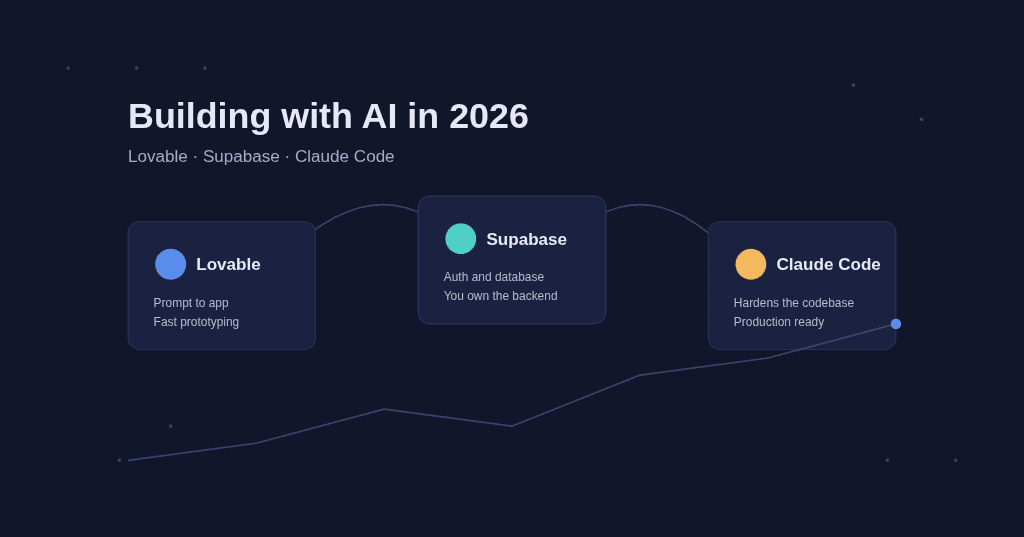
If you're building a SaaS MVP right now, the tools you'd reach for have shifted meaningfully in the last few months. Not hype-cycle shifted — actually shipped, actually usable, actually changes-your-workflow shifted. Here's what's new across the stack I use every day, and what it means if you're deciding how to build (or fix) your product.
#Lovable Cloud is no longer a one-way door
For a long time, the biggest objection to starting a project in Lovable was simple: once you were in, you were in. Your backend lived inside Lovable Cloud, and there was no clean way out if you outgrew it or wanted to self-host.
That changed in July 2026. Lovable shipped official Export, Pause, and Remove controls for Lovable Cloud, letting you migrate your entire backend — tables, storage, edge functions, cron jobs, and even user accounts with passwords intact — over to your own Supabase project.
This is a genuinely big deal for founders. It means you can prototype fast inside Lovable without worrying you're locking yourself into their infrastructure permanently. If you started a project in Lovable a year ago and have been hesitant to grow it because of that lock-in concern, that concern is now outdated.
What this means for you: if you have an existing Lovable Cloud app and want to move to a Supabase project you fully own and control — for cost reasons, compliance reasons, or just peace of mind — that migration path now exists officially, rather than requiring a risky manual export.
#Claude Code and Lovable are no longer separate worlds
Lovable now ships Claude MCP integration, meaning you can build, deploy, and manage Lovable projects directly from Claude Code's terminal, or even from a regular claude.ai chat using connectors — no switching between browser tabs and terminal windows.
Practically, this means the old workflow of "prototype in Lovable, then manually hand off to a developer to harden it" is getting shorter. A developer can now stay inside Claude Code, pull in an existing Lovable project, and work on it with full codebase context — reading files, running commands, fixing bugs — while still being able to trigger Lovable-side actions like deployment.
What this means for you: if your MVP started in Lovable and is now hitting the limits of what prompt-based building can fix — complex business logic, tricky auth edge cases, performance issues — a developer can now take it over without a messy, from-scratch rebuild.
#The real cost math has changed
One pattern worth knowing about if you're budgeting a project: Supabase's free tier can comfortably host a production app with a few thousand monthly active users before you pay anything. Lovable Cloud's usage allowance, by contrast, is tuned for early prototyping — a few hundred users with light backend activity before the credit meter starts moving.
This isn't a criticism of Lovable — it's built for a different stage of the journey (fast idea validation), while a self-managed Supabase backend is built for scale. The pattern I see most often with clients: validate the idea fast in Lovable, then once there's real usage, migrate the backend to a Supabase project you own outright, using Claude Code to harden the codebase along the way. Same features, same users, meaningfully lower ongoing cost.
#What hasn't changed (and matters more)
None of this changes the fundamentals of shipping something people will actually pay for:
- AI-generated code still needs a human pass for security. Row Level Security policies, auth edge cases, and payment webhook handling are the three places I see AI-first builds break most often in production.
- "It works in the demo" and "it works for a paying customer at 2am" are different bars. Error handling, retry logic, and monitoring rarely show up in a prompt-generated first draft.
- Speed to first version is not the same as speed to a defensible product. The tools above compress the first 80% dramatically. The last 20% — the part that makes something reliable, secure, and worth paying for — still takes real engineering judgment.
#Bottom line
If you're mid-build on Lovable and wondering whether to keep going, migrate, or start over: you now have a genuinely low-risk path to move to a self-owned Supabase backend without losing data or users, and a way to bring in a developer using Claude Code without a full rebuild. That combination didn't really exist eight months ago.
If you're stuck on a Lovable or Replit project right now — broken auth, a stalled Supabase migration, an MVP that needs to actually go live — that's exactly the kind of work I take on. Get in touch and I'll tell you honestly whether it's a quick fix or a bigger job.